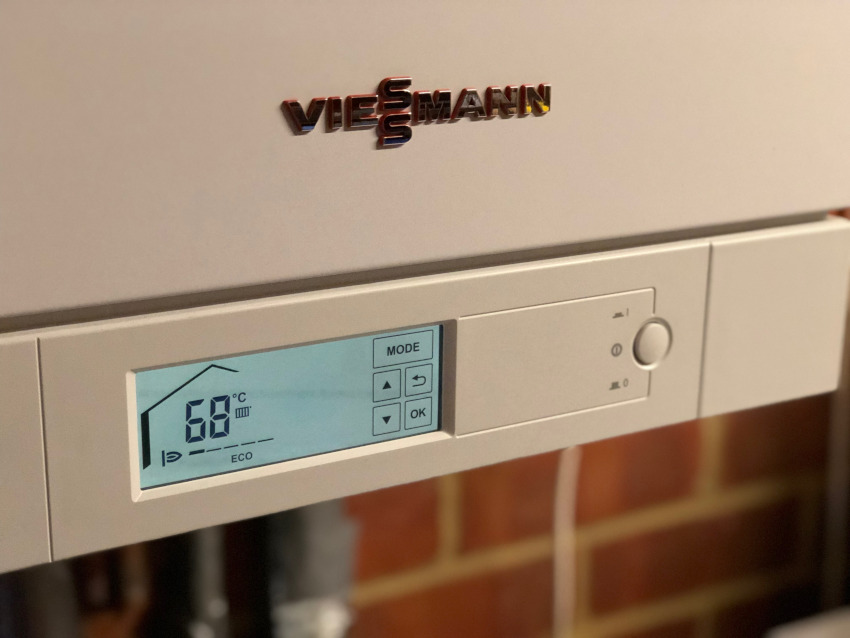
Gas boiler efficiency has come a long way in the last twenty years. The modern gas fired boiler is condensing; indeed, it’s now a legal requirement in the UK that all new installations have to be condensing units – but what’s that actually mean?
Difference between a condensing and ‘traditional’ boiler
In simple terms, as gas burns, it produces (amongst other products) water vapour. In an old-style boiler this superheated water is ejected via the flue. However, a condensing unit reclaims the hot vapour by passing it over the water that’s to be heated. Once the heat has been transferred into the water, the waste gasses are then passed into the flue. A by-product of this process is that the water vapour collects on the surface of the heat exchanger, forming a liquid (hence the term ‘condensing’) and needs to be drained away. Unlike the water that collects in a fridge, the condensate from a boiler contains an unpleasant mixture of acid and unburnt hydrocarbons – it’s a corrosive compound that attacks metals. The old style boiler exhausted this into the atmosphere as a hot gas/vapour mix but the new style boiler has to cope with a much more concentrated form.
It follows that in order to upgrade to a condensing boiler, not only does the pathway of the flue and water feed/return pipework need to be catered-for, a new drain-off connection has to be established.
As an aside, in the early days of condensing boiler installations, it was common to use a fairly small-bore pipe for this run-off, simply allowing the condensate to exit the building and drip onto the ground. In exceptionally cold weather when the water froze in the outside section of the pipe, the boiler would shutdown because it couldn’t dispose of its waste. The cure was to pour warm water on the external length of pipe.
Considering a replacement
A condensing boiler is estimated to be around 90% efficient compared to a traditional gas boiler’s 70% while producing the same heat output. Clearly it makes sense to fit one as standard in new builds. However, how do the savings work out if we look at upgrading an existing installation?
First, we have to make some assumptions:
- That the heat requirements remain constant
- That routine maintenance/servicing remains constant
- That the water return temperature is optimised for a condensing boiler’s efficiency (setting this up correctly may well have an impact on the commissioning costs as it could mean rebalancing the radiator system and flow rates)
Installation cost of a new boiler
While it’ll vary significantly depending on what else needs to be changed in order to accommodate the new boiler, we can reasonably state £2,000 seems to be the typical cost for the supply and commissioning of a new condensing boiler for a three-bed semi. This assumes the current arrangement of heating water remains (i.e. no change from a system boiler to a combined version).
Running costs compared
With quoted efficiencies of around 90% compared to conventional boilers approaching 70%, we will burn about 20% less gas. Ignoring the standing charge – a constant that remains unchanged even if we use no gas at all in a billing period – our bill will be approximately 20% lower. For the average three-bed semi, this would reduce the current average bill (Oct 2022 prices for gas) of £1,800 to £1,400 – a saving of about £400 per year.
Boiler lifespan: will a condensing boiler last as long?
It’s hard to find accurate information because condensing boilers haven’t been around for long enough to offer a large pool of data but, broadly, current opinion seems to suggest a maximum lifespan of 15 years for a condensing boiler. However, most sources also recommended changing it after around 10 years because condensing boilers seem to reduce in efficiency and, by that time, it may be operating 30% less effectively – which would put a ten-year old condensing boiler in the same league as the one it was bought to replace!
The author notes that a non-condensing boiler in a home he lived in had operated, without major fault, for over fifty years. While its efficiency would have certainly dropped from when it was new, it’s rate of degradation must have slowed down with age as it was almost impossible to measure a decline in year-to-year performance.
Is it worth moving to a condensing boiler?
On balance and using these averaged figures, upgrading to a condensing boiler should start to balance out after about year 5. Beyond that, the savings start to tail off as the condensing boiler will reduce efficiency at a greater rate, per year, than the ‘old’ boiler it replaces (the older boilers generally have more substantial heat exchangers and gas jet beds that, while not as efficient as condensers, tend to maintain their energy conversion integrity for longer). If the installation cost rises beyond £3,500 then it’s unlikely any savings will ever be made and, assuming the homeowner has the capital available, putting £3,500 into a savings account and keeping the interest would most likely offer a better return than investing it in a condensing boiler upgrade.
However, remaining with the existing boiler has two significant disadvantages:
- The older boiler is emitting more CO2 and un-burnt hydrocarbons than a newer condensing boiler so, for the sake of the environment, swapping to a more efficient boiler would be a good policy.
- British Gas, the foremost supplier of piped natural gas in the UK, have the authority to deny a device a connection to their service if they deem it to be unfit or a danger. As such, they have the power to condemn an installation, thus obliging the homeowner to replace an old boiler at short notice – this would, in all likelihood, significantly increase installation costs.
We could argue that investing in insulating the property and thus making the best use of the energy the home already consumes will give the homeowner a better financial return in most cases. Not only would this immediately reduce the volume of gas being consumed, should the boiler be swapped in the future, the savings would continue to apply. This, however, does nothing to address the environmental impact of burning gas and if we are committed to using it as a fuel then we owe it to the planet to do so as cleanly as possible. That alone suggests upgrading to an efficient unit makes sense.
Image courtesy George Lane, www.freeheatingquotes.co.uk