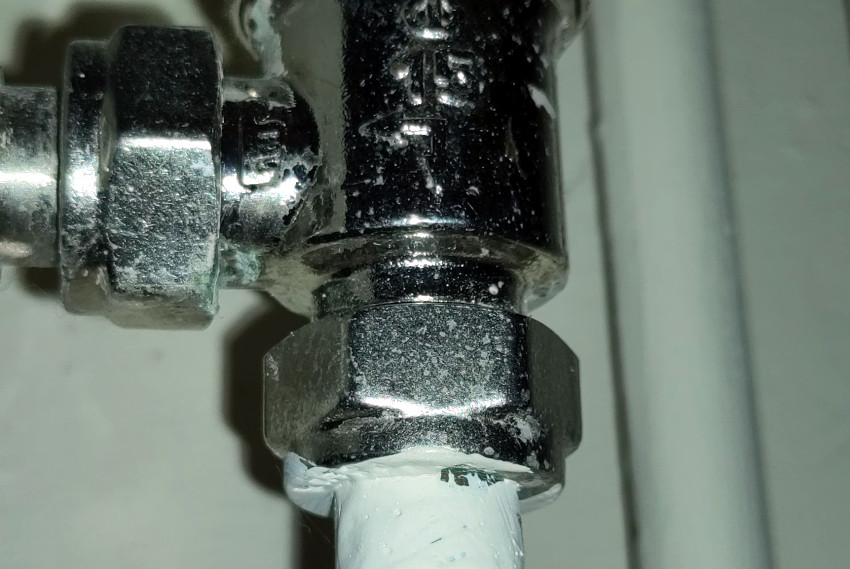
Compression fittings are common in UK homes. We find them used on central heating systems and the hot/cold water feeds to sinks, baths and so on. Once they’re done up, they rarely cause a problem but we sometimes have to break a connection and that’s where the trouble starts!
They work by slipping over the pipe and then, when the back nut is tightened, the sloping shoulders of the olive is pushed against similar sloping sides of both the fitting and the connection we’re making. As this happens, the olive deforms slightly – it’s made of brass as this is a fairly soft material – and fills the tiny gaps between the pipe’s outer wall and the shoulders of the fittings. Done properly, this makes for a watertight connection.
However, it also means the olive is pressed hard onto the pipe’s surface and, over time, a little scale typically builds up and when it comes time to undo the joint, the olive simply won’t pull off the pipe. When this happens, the temptation is to reuse the existing olive and hope it won’t leak – but they often do, no matter how carefully we clean the mating surfaces.
By far the best solution is to use a new olive each time a connection is remade but this means the old olive has to come off. Sometimes, we need to remove the olive to continue with whatever job we’re doing anyway so it pays to know how to deal with a stuck olive.
First of all, be careful not to deform the pipe at all: the whole principle of the olive requires the pipe to be a reasonably round and uniform thing so use care and go easy! Try twisting the olive with a pair of water pump pliers and see if gentle rotating as you pull towards the open end of the pipe is enough to free the ring. It sometimes works but if not, it’s time to reach for the hacksaw.
Before you start, twist the olive to a point of maximum friction – this will help to hold it steady when you make the cut. If it’s spinning fairly freely just use one hand to hold it and go easy when you’re applying cutting pressure with the hacksaw.
Access is usually cramped so each situation will be slightly different but we find cutting the olive at an angle is both easier for access and more controllable. Using whatever motion you can get and a small hacksaw, make a cut into the olive. To start with, it’ll be easy to avoid the pipe because the olive stands proud of the pipe’s diameter. Just keep the hacksaw fairly parallel to the job and there’s no reason to catch the pipe with the saw’s teeth.
Obviously, as we cut ever closer to the pipe, we’re increasing the risk of causing a problem so go easy and stop when you’re about half way through the olive’s side. At this point, you should have an untouched pipe and an olive with a partial slit in it. This is ideal: now take a flat-bladed screwdriver – a 1/4″ or 6mm one is probably about right – and, using a twisting movement, ‘undo’ the olive. If you’ve cut far enough into it, it should snap free at this point. If not, stop and try deepening the hacksaw cut a little more. Once the olive does break open, it’ll be easy to remove it from the pipe. Clean up the metal particles, scrape off any paint, etc that will be in the way and use some plumbers wire wool to clean the surface of the pipework.
Before installing the new olive, check the mating surfaces of both the fitting and the connecting piece to be sure there’s no loose material or obvious defect that could prevent the surfaces from sealing up, check the end of the pipe is clean and free of any burrs then apply some plumbers mait around the shoulders of the olive. You won’t need much, just a thin coating is ideal. Offer the parts up and tighten the nut by hand – the pipe will still be loose at this point. Holding the static part with something suitable (an adjustable spanner is often the most ideal tool), use a spanner to tighten the compression nut. How tight this needs to be is a bit of a guess I’m afraid but with new, clean fittings, it is usually not much more than 1/8th of a turn past ‘hand tight’.