Every home should have a few tools stored somewhere but, depending on the task you want to undertake, having the right tools will be either essential or just makes life easier!
We’ve added costs where we can but, as with all tools, it’s easily possible to spend way more than these figures.
Basic home-maintenance
Hand tools
Set of screwdrivers. The ones you will use the most are: 3mm straight blade (electrical connectors in plug-tops, light fittings and so on); 6mm straight (resist the urge to use it as a chisel or can-opener); Pozidrive #2 and #3 (most woodscrews use Pozidrive these days).
£3-5 each
Radiator key. This is a small ‘T’ shaped tool with a square hole in the end. It’s used to bleed radiators to get air bubbles out of them.
£2-3
Pliers & mole grips. Useful for all kinds of jobs where something needs to be held!
£5+ per pair
Claw hammer. Fewer and fewer things seem to need a hammer these days – and if you’re using it to make something fit then you’ll probably end up doing more harm than good – but every toolbox should have one!
£5
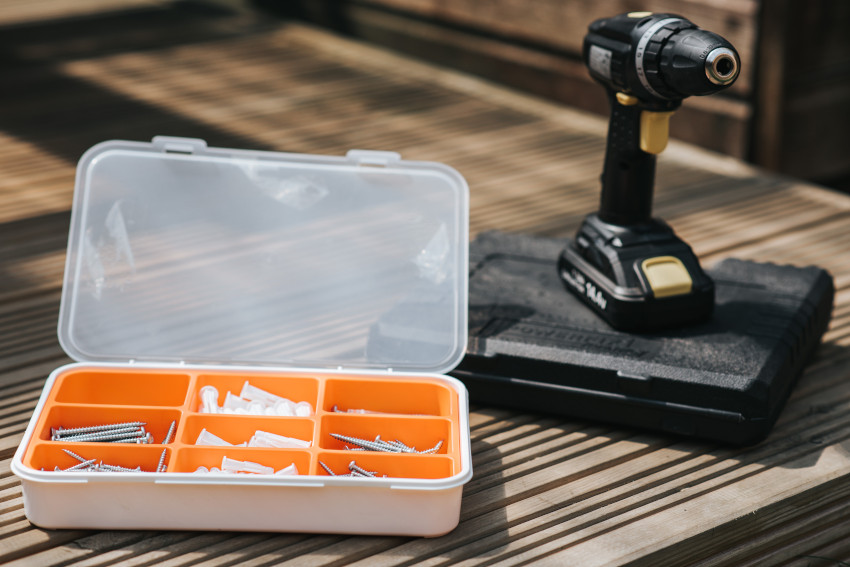
A selection of wood screws. Don’t go out and buy one box of each kind: there’s such a vast number for styles, lengths and diameters you’d waste money – just keep any you undo or are left over from a project. If they were used in that, there’s a good chance they’ll be used in this!
£as required
Electrical tape. No, not for jointing wires (please no! That’s just asking for a house fire) but it’s strong, the adhesive is mostly waterproof and it peels off most things easily without leaving marks. It’s an ideal way to attach a magnet to a broom handle if you need to rescue a set of keys dropped in a drain and an ‘X’ of electrical tape on a tile will prevent a drill from slipping as you start the cut.
£1 per roll
Power tools
There’s not much need for power tools unless you want to start making shelves or taking on jobs like refitting floorboard, etc. However, a drill with hammer mode (either battery or mains) will be very useful to put up shelves. A set of drill bits for masonry, wood and metal, each in sizes from 3mm to 10mm would be about right.
Drill: £40 upwards (realistically, £80+ if you want it to last)
Bits: Mixed set for occasional use, £10
Miscellaneous
Rags: A roll of industrial hand wipes sounds first-rate but an old towel or two will be perfectly adequate.
£0!
Some spare fuses. Have a few 13A (brown), 5A (black) and 3A (red) plug-top fuses in the toolbox. If you still have a main fuse box that uses wire fuses then have spare fuse wire (and please: arrange to get that panel updated: a wire-fused distribution board is well past its sell-by date!)
Fuses: £3 for a card of 3
Plumbing-specific tools
As soon as you look at doing anything with the plumbing, there’s a list of tools that become rather important to have – or to be able to borrow. Here’s a list that we find invaluable (most will also double-up for other, more general jobs too).
Adjustable spanners. A 200mm one is about the most useful size but if you can get a 300mm one as well, so much the better (these are the lengths of the tool – which generally relates to the jaw opening size). Used as a pair to work on plumbing connections.
£10 each
Bowl: A small kitchen mixing bowl that just fits under a radiator connection that needs to be opened will catch the drips. Special bowl-like attachments are used by the trades but they don’t hold as much liquid – those people generally work faster than we do! A small mixing bowl can also double-up as a tub to make up powdered wall-filler or as a temporary storage pot for screws, etc.
£free if you nick it from the kitchen….then £5 to replace the one you nicked from the kitchen when you realise the putty has set rock solid on the edge and you can’t return it to cooking duties!
Joining compound (‘Plumbers Mait’). A small wipe of this around the back of an olive will massively reduce the risk of having a leak; it’s a god-send.
£6. One tub will last you a lifetime.
PTFE tape. This is also a leak-prevention product. It’s a very thin tape that is tightly wound into the threads of connections before the parts are assembled (three or four turns is about right) and seals the joint up as the nut is tightened. Can’t be used to seal an olive (that’s jointing compound’s job) but it’s neater and used when the thread itself is the part that stops leaks (radiator tails, for example).
£0.40
Spare olives. The ‘olive’ is the brass ring that slides over the pipe and is the bit that presses against the inner surfaces of the fitting, the outer of the pipe and the inside of the nut that’s tightened-up behind it: it forms the water-tight seal so each time a joint is undone, a new olive should really be used. The two common sizes are 15mm and 22mm so have a few of each and store them where they can’t be bashed about otherwise they’ll deform and leak.
£5 a pack of 5
Hacksaw. A small hand-held hacksaw is invaluable. When (and it will happen) you encounter an olive that won’t twist off the pipe it’s been used for, cutting it off is the only solution and a handheld hacksaw will be the only tool that’ll fit into the cramped space.
£4. Buy some spare blades too: £4 for a pack
Radiator tail key. If you need to change the ‘tails’ – the short connections on the ends of radiators – then you’re stuck without a tail key: it’s an oversize Allen key that fits inside the tail itself and allows you to tighten / loosen one. There’s no alternative tool for this job that won’t damage the exposed threads.
£4
Pipe cutter. So much easier to cut a length of copper or plastic pipe squarely and neatly with a ‘cutter than with a hacksaw – and no chance of leaving bits of debris in the bore afterwards. If you get the adjustable kind (that will fit both 15 and 22mm pipes), practice on a spare bit of pipe a few times before making that important cut so you get the ‘feel’ of how many turns to make before tightening the cutter a little: increase the cutting pressure to much, too early and you risk deforming the pipe.
£10
Water pump pliers. This is an adjustable spanner, basically. The jaws are deeply serrated (some come with protective plastic jaw liners for use on chrome-plated parts) and one ‘leg’ moves on the hinge to give you a range of different opening sizes. Personally, if we were forced to only have one extra tool, we’d opt for a second adjustable spanner rather than some water pump pliers: they’re more useful generally.
£12
Pipe bungs. These are usually sold in pairs and are used to close-off an open pipe – to stop water leaving a header tank for example. Good tip though: tie a length of line between the two of them (about a meter long will do) so you can pull the one in a tank back out without having to get your arm wet a second time! They’re only ever used in header tanks so we leave ours hanging by the string in the loft so they’re immediately next to the tank. Nothing worse than getting the steps out, getting up into the loft and only then realising you’ve left the damn bungs in the garage!
£5
Electrical work tools
Working on the electrics should only be done if you feel competent to take the job on safely: get the plumbing wrong and you might soak a carpet before you shut the water off – but get the wiring badly wrong on a metal-plate light switch and you could electrocute someone. Of course, always make sure the power is off before you start work – and that it can’t be turned on by someone else who maybe doesn’t realise you’re working.
Wire cutters. The combination plier/cutter never seems to do the cutting job very well for us but they’ll do for occasional use.
£5
Wire strippers. Setup correctly and these will make short work of removing insulation without damaging the wire it protects
£5+
Neon ‘live wire’ tester/screwdriver. This can be a life-saver: touch the screwdriver tip on a live wire and it’ll light up a bulb in the handle (you need to be holding the metal top or clip of the screwdriver and be ‘earthed’ yourself though). Of course, you’re not going to be messing about with live circuits anyway, are you – but it’s always wise to check before you touch a wire that could be live.
£3+
Continuity tester/multimeter. A simple meter that can test for an open or closed circuit is all you generally need but anything that offers this will do a range of other functions, too. If it beeps to let you know a circuit is closed, so much the better – you generally can’t watch a screen AND get both pins in the right places at the same time.
£5+
Other tools will be required
Of course, both plumbing and electrical work will need both raw materials (pipe, taps, wire, switches, etc) but they’re job-specific so we won’t list them here. Equally, if you were, say, moving a radiator or light switch then you may need to put holes in walls, chase out a channel for a pipe or cable run and so on. These are beyond the scope of an introduction like this but we’ll touch on jobs like these in later articles.