The sewer network isn’t included in a home buyers survey – we feel it should be. Faults tend to develop slowly and, when they are discovered, are often bigger problems than they may have been had the fault been detected sooner. As such, having a basic understanding of how a sewer works may help the homeowner identify a fault before it gets too serious or at least know when something needs a little attention.
Two different sewers
In the UK, we generally have two systems in operation. One caters for foul waste (toilets, sinks and other contaminated water) and storm – surface water – drainage. The reason for this is that rainwater doesn’t need to be passed through a settlement tank, be filtered and then treated before being discharged into a river: if it wasn’t for the fact that we’d captured it from a roof or open area, it would have soaked into the ground anyway. There’s a lot to be said for disposing of rainwater into a soakaway, not least because passing it directly to a river swells the volume of the watercourse far quicker than it would if it were allowed to soak into the local environment.
In some homes in the UK, both storm water and effluent are taken from the property in the same pipe – a combined system. This hasn’t been standard practice for many years but it’s simply not economic to modify properties with a combined system and split the services.
Unfortunately, when buildings are extended by adding conservatories and so on, it’s quite common for builders to route rainwater into foul drains. The problem this brings is obvious to us when it rains hard: the foul drain is suddenly overloaded by the additional surface water it’s being asked to carry. The knock-on effect of this is that the water treatment plant is put under significant stress, often causing them to have to allow an overspill of untreated sewage into a river; something that is an environmental disaster. Building inspectors should refuse to sign off on a property that’s had a rainwater downpipe connected into a foul sewer unless the property is a combined system.
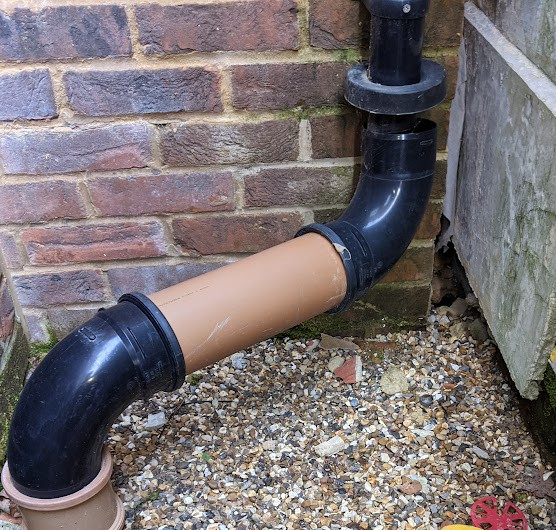
It’s even an issue that affects new builds. The image at the top shows a rainwater downpipe (68mm – the standard for above-ground rainwater pipework) loosely fitted into a 110mm pipe, which is a branch of the site’s foul sewer. Not only is this highly questionable practice, the junction is unsupported and the weight of rainwater falling into the downpipe will cause the horizontal branch to collapse, allowing rats from the sewer network to have free access to the surface.
Once in the ground, both storm and foul pipes are the same size (110mm/4″ for most domestic properties) and usually made of the same materials (plastic pipe). In older installations, it’s common to find pipes made of clay, pitch fibre or iron – all are perfectly serviceable as long as they’re not tampered-with.
Inspection points
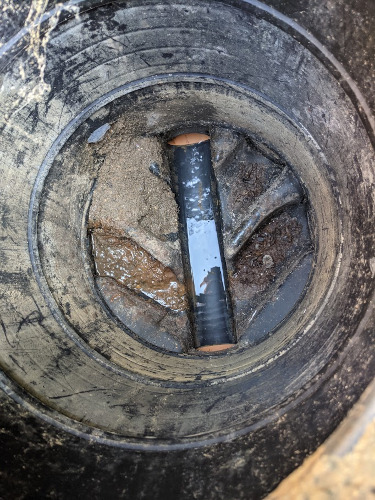
General principle of all drains is that each time there’s a change in angle or a new connection is introduced, a chamber (‘manhole’) is installed. This allows for rodding, a blockage-removal process where a rod with an attachment is pushed into the pipework – if a pipe has a junction where two connections meet but there’s no chamber, it’s next to impossible to rod both branches correctly. Chamber lids for foul drainage should generally be screw-down kinds to prevent the cover from lifting in a serious back-flow situation and, if they’re within a building (as happens sometimes when an extension is built over an existing chamber), they should be double-sealed to prevent odours. Chamber walls will be brick lined and have concrete ‘benching’ – the bed the pipes sit in – in older properties, while newer homes will be entirely plastic material. The author would have clay pipe installed if the choice were offered; while it requires more skill and knowledge to lay clay pipe correctly, when done properly, it is almost entirely impervious to rodents.
Know the flow
It pays to know in advance where the ‘run’ goes, what connects in and where – that way, if ever there’s a problem you have a good idea where to look. This can easily be done by lifting the chamber lids and going round the house flushing each WC in turn and seeing where the water flows. If ever there’s a case of rodents being discovered in the property and a pest controller suspects rats, they will almost certainly want to know where the foul drain goes, what’s connected and what (if any) changes have been made to the pipework.
Some fresh air
One thing to be aware of: a foul sewer will almost always have an open end – this is to allow air into the system – but it can also allow a rodent to exit the system! Blocking the open end is a very bad idea (flushing a WC will cause sufficient suction to empty water traps in the house if that happened) but there’s nothing to prevent a homeowner from securing a mesh cover over the open end of this stack pipe – and it will prevent a bird from falling in, if the vent end is outside. If the stack is internal, the builders should have fitted an AAV (air admittance valve) to the open end and it’s worth checking that this is in good order; a loose or faulty AAV will usually cause a distinctive ‘not flushed’ smell in the room. They’re cheap to buy and it’s just a push-fit – so well within the DIY-er’s ability to replace.
Who owns a sewer?
The general rule is that, while a pipe is only serving one address, it’s the property of the homeowner. As soon effluent from a second address joins the pipe, ownership of the pipe and the maintenance of it transfers to the water board or its agents. A pipe run that starts with your property, has a chamber in your garden (with just your pipe in it still) is yours – and it’s still ‘yours’ as it enters next door’s garden, right up to the point where their pipe connects in. Obviously, if there’s a problem in the length of pipe in your neighbour’s garden, dealing with the issue may mean striking some kind of agreement with the person in the adjacent property. It also means nothing should be done to the neighbour’s chamber without the permission of the water board – while they rarely take issue with trivial work like swapping the cover to something more in keeping with the garden’s decor, doing something like installing a one-way valve to prevent rodents accessing a property or to guard against a back-flow will need permission – and it’s usually declined.
There are exceptions to the general ‘ownership’ rule (private estates, and so on mainly) and it’s worth checking with a drainage contractor or other specialist if there’s any doubt.