Having covered the basics of how a solar panel works earlier, we can now look at the practicality of using them. For now, we’ll assume a PV (electricity generation) rather than water heating as that’s by far the most common – but the location, direction and angle of mounting, practical application and variable production throughout the year is broadly similar.
Getting the most out of a solar panel installation
In the UK, the sun will rise in the East, track South and then set in the West (yes, technically, it’s the Earth that’s doing the movement but it’s the relative movement that’s key!). If you were to mark the length of a shadow cast by, say, a flagpole at midday in summer and then compare it to the same shadow cast by a mid-winter sun then you’d note that the shadow is significantly longer – this means the sun is lower in the sky. Not only are winter days shorter, the sun’s power is significantly diminished because the rays have to pass through a lot more atmosphere before they reach us. In total, it means the generating capacity of a solar array is diminished in the winter months. Obviously, it makes sense to have the panels facing the sun but therein lies a compromise: ideally, we’d continuously track the sun and make sure the panel is constantly exactly perpendicular to the light but that would require each panel to be moveable on two axis. However, this is complicated and the fractional gain we would get means it’s not worth the trouble – but it is worth mounting the array on the face that is exposed to the most sunlight and that, for the UK, means South.
Equally, if the panel isn’t angled to be perpendicular to the sun’s maximum point then there will be energy that is lost.
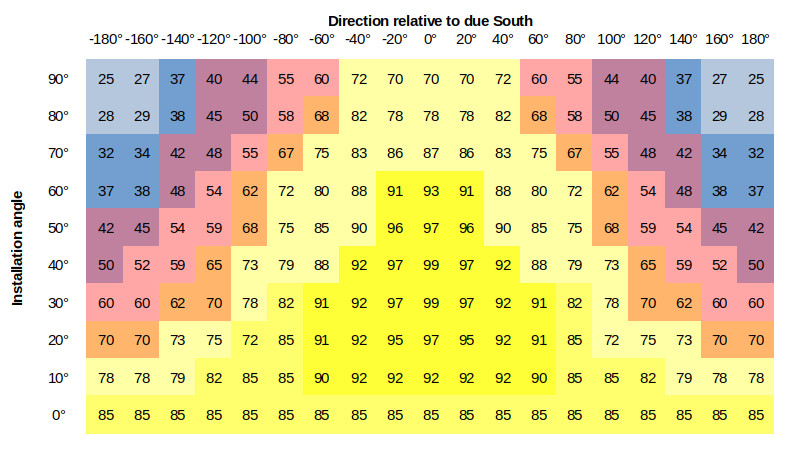
This graphic shows the relative performance of panels and how they fall-off when not facing due South. From this, it can be seen that the optimum installation angle is about 35o – which happens to match the typical UK house roof.
To further complicate matters, where the installation is in regards North or South of the UK will also have an impact – that stick’s shadow in, say London, will be shorter than an identical stick’s shadow in Glasgow because the further north we are, the lower the sun appears to us (indeed, go further North and there are winter days when the sun never appears above the horizon). For example, the average irradiation for the South Coast of England is about 1.2GWh per square meter per year, falling to around 0.8GWh/m2/year in Northern Scotland.
However: the direction of the roof, its angle and where we are in the UK are all variables we usually can’t change easily without significant disruption(!) so we have to work with what we have. At this point, we should consider the potential maximum gains and then factor in the local variables such as angles, direction and location – and then we should be able to work out the generating capacity that is realistic for our situation.
All this assumes the panels are in full sun and not shaded by trees, other properties and so on. In some cases, where a PV array will be partially shaded, it might be more efficient to use multiple inverters so that the un-shaded panels’ efficiency is not compromised by the low-producing panels. However, this is a deeply technical aspect of an installation and will vary depending on the exact situation and how the power is being used.
Obviously, the sun’s usable power varies from day to day because of clouds, rain and so on. As such, its normal to look at the average generating capacity over time rather than the peak that is possible. Power consumption in the home varies from day to day – so by using averages for both sets of data (your electricity bill will tell you how many KWh units you’ve used), we can work out what difference a PV array will make to our likely future bills.
Once installed, PV panels are generally maintenance free: while a little dust and surface debris will collect on them, rain will usually wash the majority off and their location keeps them safe from accidental damage. However, inverter(s) reduce in efficiency over time and it’s generally considered wise to replace them every 15 years or so – at the time of writing, a typical replacement is in the order of £1,000.