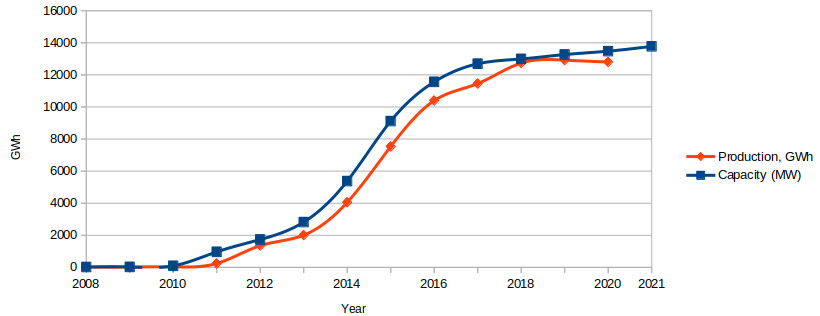
The UK uptake of solar energy generation has slowed significantly, with less new capacity coming on-line in the four years between 2016 and 2020 than was added in 2015 alone.
This graph (below) using Government data shows capacity – in simple terms, the number of panels that are installed – and the total power generated.
The two lines do not track perfectly because the available sunlight will vary from year to year and have an effect on the total power that can be produced.
The UK is far behind the 2012 promise of having nearly 4 million homes powered by the sun by 2020 (that translates to having about 22GW of capacity available – the current total for the UK is 13.78GW) that was made by Greg Barker, energy minister at the time of the commitment. Indeed, with the current growth rates, the country is unlikely to meet that level of generation potential for another 15 years.
While PV is generally used within the home, any excess power can be sent to the grid for national consumption and suitable payment made to the home owner for its use. These Feed in Tariffs, as they were known, were stopped for new applicants in 2019 and a new scheme – the Smart Export Guarantee (SEG) – was created. However, SEG have limits on the size of the PV system and is only available for homes with a class ‘D’ or better Energy Performance Certificate. The capacity limitation of 5KW is a particularly bizarre restriction: the size of PV array is naturally limited by the space available and local planning rules so an additional rule seems somewhat arbitrary – and to impose an artificially low limit on the power a system can return to the grid goes against the very idea of PV helping to power the nation.
Perhaps, if the current rules were re-examined, the UK would increase the uptake of solar energy solutions once again and make significant progress towards hitting that 2020 target – albeit a few years later than planned.
Government source spreadsheet (XLS)