
A fundamental problem with UK homes is that, in general, the central heating system uses one pump to circulate the water through all the radiators in the house. This means that either the whole system is on or off. If one person is working from home and feels the need for a little heat in the study and kitchen, the option is to turn the heating on for the whole home or go without.
To help improve things, we can fit TRV’s to the radiators. These will at least control the temperature of individual rooms but we’re still heating all the bedrooms when we only really need heat in a few rooms downstairs. Equally, TRV’s do nothing to help if we want to add a little heat to a bedroom at 4pm for when the children come home but we don’t need the master bedroom warmed up for another five hours.
Modern thermostats can do clever things like shut the heating down early if the room its monitoring is cooling slowly enough for it to last until the usual ‘off time’ or start early if it’s exceptionally cold. While upgrading the thermostat itself is (fairly) trivial and will doubtless save energy if configured well, they are still switching the entire system on or off, rather than focusing on specific rooms we want to heat. The one advantage these ‘intelligent’ thermostats offer is that we can turn the heating on and off remotely – for the odd occasions when we all go out and don’t need heat or realise we’ll be coming home early and want a warm home. Unfortunately, evidence suggests that the majority of users tend to use the boost for an ‘on’ period rather more than to increase the ‘off’ times – speaking personally, the author doesn’t see such limited control as a very ‘efficiency minded’ upgrade.
If we really want to be smart about it, we should be controlling individual room temperature. A radiator that can be told to shut off completely (or drop to a preset minimum) when we don’t need the room it’s in and yet keep the room at a higher temperature when we do need it would be far more energy efficient because we can focus the heat and so save energy.
Such a system does exist. Honeywell have it by the name ‘evohome’. It’s a small mobile-phone sized display and ‘brain’, some remote switches to control the boiler, pump and central heating and TRV’s that are controlled remotely.
Using such a system, it’s easily possible to define zones: master bedroom, bathroom, child 1, child 2, living room, kitchen and so on. Each zone has it’s own heating times and temperatures (warm bathroom in the morning but a degree or two cooler for the evenings? Easy). If a zone is on but not quite warm enough for the person in the room at that particular time, they can adjust the radiator valve and call for more heat – it’ll automatically reset to the standard configuration at the next programmed time so there’s no chance of someone accidentally leaving a room on ‘full’. It can control the hot water system too, again, an override setting means it’s possible to demand hot water to be on when it’s usually idle.
After a lot of thought, we decided to switch the home over to an evohome system. It’s not a minor job by any means: every radiator needs one of their ‘smart TRV’ heads, the wall thermostat is removed (it’s no longer required when you’re monitoring rooms individually) and, most concerning to us as amateurs, the wiring between the boiler, pump, hot water thermometer and control valves need to moved over to the new system.
Fortunately, some years previously, we’d moved most of our radiators over to TRV’s and, because the evohome’s radiator head is designed to replace existing TRV heads, most of the room upgrades would be fairly painless: remove the old head, replace with new – it’s a three minute job. There were a couple of radiators that we never fitted TRV’s to and they needed to have new tails and valve bodies installed before the evohome head would work; this called for a full system drain-down which is a slow process and detailed elsewhere on the site as a project in its own right. In this article, we’ll explain the control system and switch-gear installation.
evohome is wireless: each TRV head, the temperature sensor for the hot water and the switches (relays to be more accurate) are all controlled from the master panel without wiring. This is a massive benefit: we originally assumed this controller would have to be stuck in the airing cupboard where the old controller was but in practice we leave it on its little charger/stand, tucked away in a corner of the kitchen. It’s rechargeable too (taking standard NiCad or Li-ion AA cells) so, during configuration setup, it’s easy to carry between rooms. However, in order to install it, we do need to understand what all the existing wiring does – and while it’s simple in principle, looking at the bunch of identically-coloured wires in the airing cupboard and knowing there’s no easy way to reverse this change is a daunting prospect!
Older heating / hot water systems in the UK generally fall into two kinds: The ‘Y’ and the ‘S’ plans. We’re not going to explain the difference but ours is a ‘Y’ so we have one mid-position valve and the boiler to control – Honeywell offer a wiring diagram in their installation manual that helps but it still took a bit of figuring out!
Our only ‘gotcha’ was that, on stripping the old wiring back, we found that the boiler had a five-core cable running to it. Three were obviously live, neutral and earth – but the remaining black pair confused us and, both being the same colour, we couldn’t immediately work out which was connected to which terminal at the boiler end. Of course, we had the power off during all this so the easy solution was to disconnect a coloured wire from the boiler end, short it to a black one and then check for the closed circuit at the airing cupboard end. It turns out, one black was to power a boiler-switched pump (unused in our case) and the other was the ‘boiler start’ switch. Phew.
Working though the circuit wasn’t too hard; we used one double-socket box to hold a strip of terminals for the various interconnecting wires and then ran short sections of mains cable out to the two relay boxes. The tank thermostat connects to its own ‘sender’ box and we mounted the whole set on the wall next to the hot water tank, as per the photo (painting the cupboard wasn’t on the agenda, sorry!):

Each relay unit and TRV head needs to be ‘tied’ to the master controller (radiators can be named so it’s easy to program zones based on the name of the room, etc) and the system is ready to be configured. This is very much as you would do in any central heating/hot water system with the added touch that it’s possible to setup one zone that’s about right for most things and then copy it to other zones, modifying them to be appropriate for that part of the home. We now have a master bedroom that’s warm when we get up along with children’s rooms that warm in time for their morning (but then all shut off to a defined minimum until various times in the evening), a dining room/work-from-home space that is warm during the day and a living room that ticks over at 18oC until the evening when it’s occupied by people rather than being just a glorified corridor between rooms. It’s incredibly flexible, as this graphic shows:
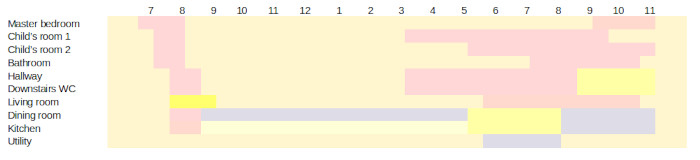
Each day can have its own settings per zone (we generally use ‘weekday’ and ‘weekend’) and a room can be boosted for a length of time from the controller if there’s a short-term need to override the usual configuration. evohome is not a cheap system to buy: the controller, two relay boxes, the tank thermostat and eight radiator heads was around £900. Had we called in plumbers to fit the radiator valves and an electrician to fit the controller, it’d probably have cost almost double that. However, with the recent huge rises in the cost of gas we expect it will pay for itself rather sooner than we originally anticipated. We also took the opportunity to change a couple of radiators, flush the entire system and swapped the pump – so we should be pretty maintenance-free for a while, too!
Would we install it again if we moved house? Without any question we would. In our opinion, this level of energy management should be standard in all centrally-heated new builds and should be a serious consideration for anyone in existing housing stock who has an eye on their energy consumption.