Given the pressure on water supplies in the summer of 2022 (parts of the UK on hosepipe bans and all regions being advised to not waste water) it makes sense to consider our water usage as part of our overall economy/environmental impact.
The average home uses about 30% of its water just by flushing the loo – but we can cut the volume of water in the cistern (within limits) easily.
One measure we can all take is to reduce the volume of water that’s used when we flush the loo. Not too long ago, the Government passed a law limiting the flush volume to not exceed 7.5 litres – in years gone by, it wasn’t uncommon to find 14 litre cisterns. Clean water – literally – going to waste.
The author recalls a passage in Flushed With Pride: The Story of Thomas Crapper where a couple of ping pong balls were used as the test of a powerful flush. Look it up if you think we’re pulling your leg, it’s actually quite a good read.
Now, we can’t pretend this is a comfortable subject for everyone but it’s a fact: the modern loo has been designed so it need less water to… well, remove what’s been left behind. 7.5 litres should be more than ample – 6 should do it, really – and if there’s only liquid waste to deal with then even less than 6 would work but let’s not get carried away.
If you want to know roughly what your loo uses, flush it and time how long the water rushes into the pan. It should be around 1 litre per second.
Happily, we can modify the volume of water in the cistern (within limits) easily. Some syphons will have an adjustable plug/stopper that changes the amount of water that is drawn down into the bowl – but in our experience, these can be very difficult – if not impossible – to adjust once the cistern has been fitted. Adjusting the ball float so it shuts off the fresh water supply earlier is usually possible: either the ball can be moved vertically lower down the arm (so it ‘floats’ sooner) or the arm itself can be bent downwards a little.
Of course, you could put a house brick in a plastic bag and carefully lower that into an empty space in the cistern: it’d work just as well (say what you like but you can’t deny our style!)
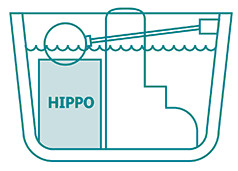
The alternative – and neater – solution is to buy a bag that slots into the cistern and retains a volume of water that would otherwise get flushed. Entirely reversible if things don’t work out so well worth looking into. Hippo is one such company, British owned and they do bags for both old (large) and newer (smaller) cisterns.